Strategic leadership. A term referred to frequently throughout my journey as a Cadre 38 member of Doane University’s Educational Leadership program. This term, like many others, showed up over and over- a way to have the phrase not only become a part of our vocabulary, but to embed the approach to the way in which we conduct ourselves at work; to become embedded into the way we go about our daily lives.
Systemic change, the belief that with intention, you can create fundamental systems that even without your presence create structure in efforts to establish impact and routine.The greatest leader, our group was told, were those who strategically developed plans- systems that would deliver security and continue fluency, even without your physical presence. These systems, unique to the individuals they serve, grant peace, positive productivity and develop a sense of moving forward. Systems create foundation, a solid structure to establish norms, expectations and an overall direction in how to get things accomplished.
If the systems I created in school were working- then why wasn’t I using this technique to create systematic change within my own household?
Last year, while in a family therapy session with our five year old, his therapist, listening to our concerns, dropped the previously determined agenda and worked, in that moment, to develop a system centered around an immediate need: getting everyone out the door on time for school, and without frustration. A Maslow’s hierarchy of needs moment- focusing on the foundational immediate concern, in efforts of eventually reaching self-actualization, or overall wellness. A go big- to go small moment. Finding a way to set our children up for success, all by starting their morning with accomplishment, kindness and joy; providing a positive start to their day. All in hopes of continuing the trend, working to lessen the chaotic moments, and instead implement predictable stability.
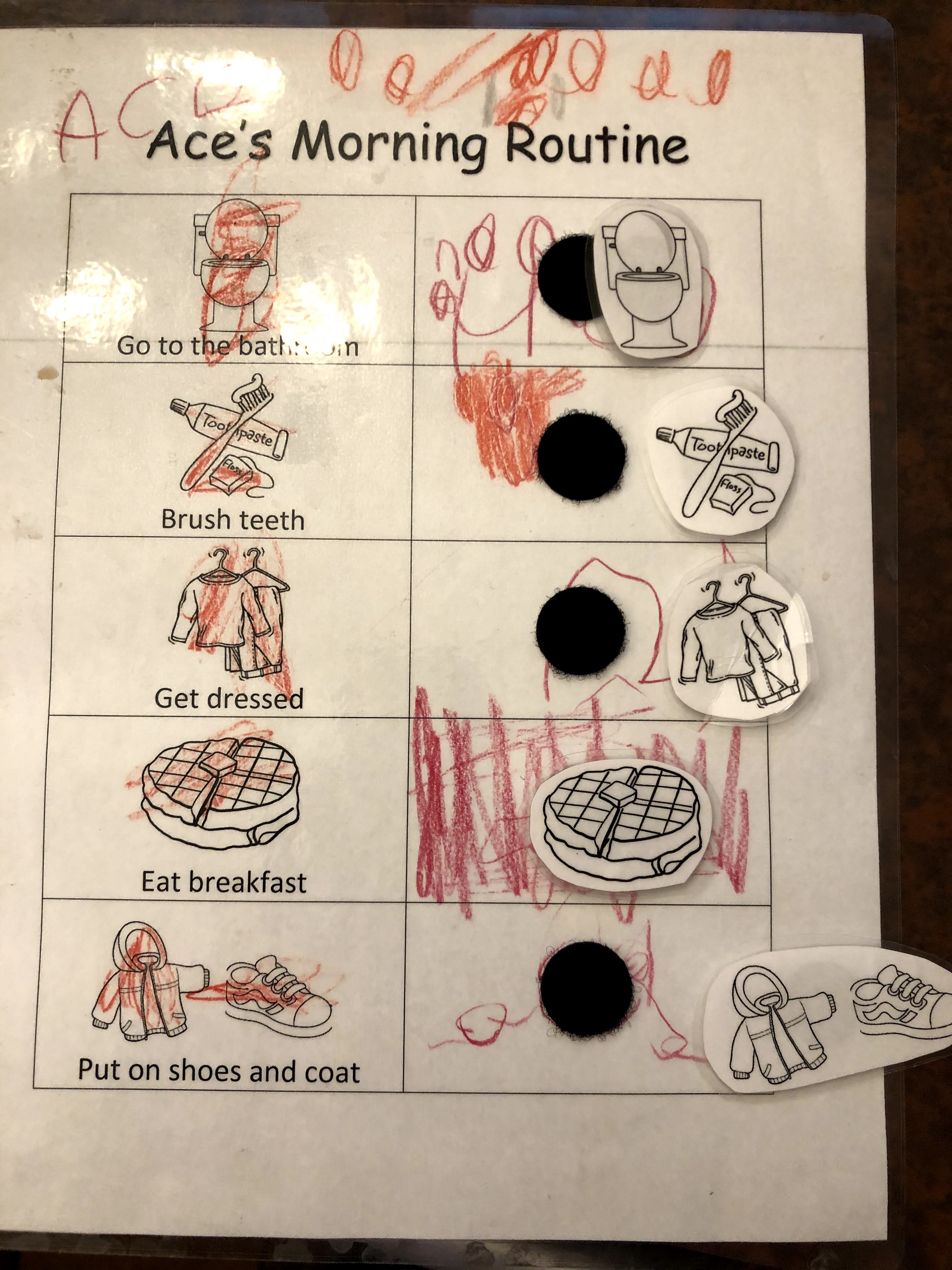
We left the therapist’s office, only twenty minutes later, with a plan- a laminated velcro chart for both our seven and five year old. A simple magnetized 8×11 sheet of paper that included each of the five essential morning tasks: going to the bathroom, eating breakfast, getting dressed, brushing your teeth, and putting your shoes on. Simple and effective.
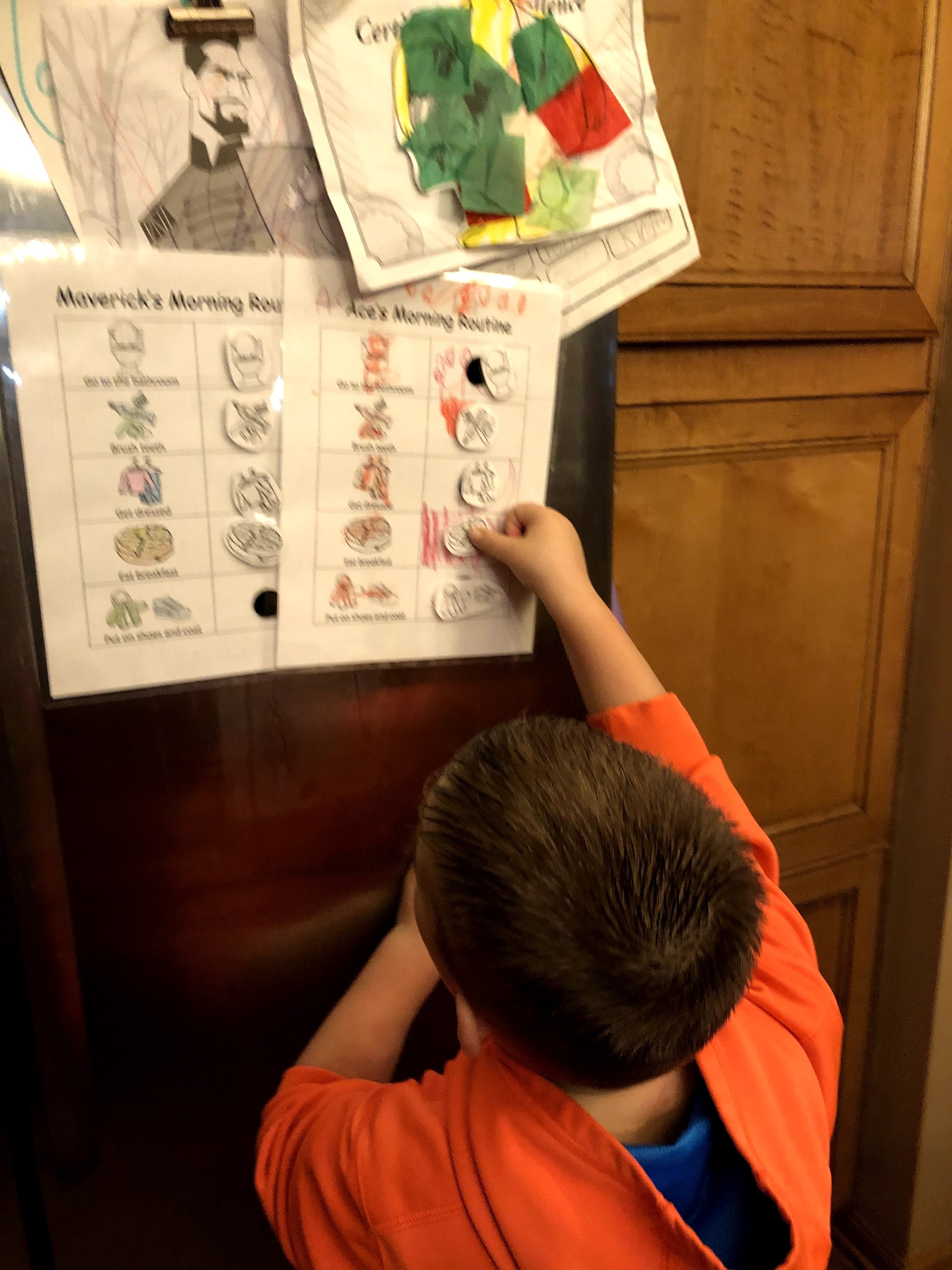
The chart served as a straightforward, reusable, and familiar visual to assist our older boys in building independence. Getting things done by themselves, without reminders that, with increased frequency, often led to frustration and difficult mornings. This was an age appropriate structure that allowed our children to feel success rather than being viewed as let-down. A system that worked on its own, day after day, until it became so embedded in their daily routine that the visual was no longer needed, but rather a habit was established.
Creating systems within a school system, the intended audience for my graduate program, seemed incredibly necessary and logical. In every given school, on any given day, there are literally thousands of moving parts. Without systems, chaos will erupt. While the content of the system may not be easily agreed upon, the idea of needing the structure is. The same is true within the walls of our family home. One house, with six independent needs creates hundreds of moving parts, every single day.
As I contemplated the missing pieces, the systems that needed to be created in efforts to correct or address any recurring obstacles in my classroom, I suddenly began thinking about the many ways the same systemic approach could benefit my parenting skills. Well managed systems catered specifically to our family, would ease tension, free up time and provide a way for me to teach some of the values I deem as non negotiable for our children.
Acknowledging the need to go slow in efforts of moving fast, I accepted that not all areas of concern could be addressed all at once. In fact, after doing an honest inventory of our problem areas, I recognized the need to establish a way to rank each opportunity of growth from urgent to well, maybe one-day. Understanding that there would likely be no one way fits all solution, I knew I had to be intentional about how and when to approach each difficulty.
My inventory included, but certainly was not limited to:
- Increased independent reading time. As in actually doing the reading your children’s teachers want you to do and sign off on. Oh- and not just completing this, actually having your child enjoy reading, rather than it be a constant battle.
- One chore per child per day. You know- rather than waiting for Mom to totally lose her cool after being completely overtaken by house chores. Help- as in from the tiny humans you created. Help that becomes routine rather than a constant nag and complete annoyance.
- Eliminating the Screen Time ShowDown. Actually figuring out a way to manage screen time without raised voices or hurt feelings. Not wanting iPads and video games to control our children’s lives, but also wanting to give them a way to earn this privilege- both have autonomy over their choices, and well- to give you a few minutes to watch the shows you enjoy, all in hopes of regaining your own sanity.
- Time for All. Ensuring each of our four children get individual time with Mom and Dad, or at least Mom or Dad every week. Every child experiencing a genuine individual moment- every single week.
- Self- Care. Figuring out how, as a parent, to actually get consistent time to yourself. Not just the time needed to do the endless amounts of chores, but time to do the things that make your own heart sing. Basically to do the self-care so many people throw down your neck.
Not really sure what to add to your list?
Start with reflecting on the moments that turn your seemingly normal day, the sort of annoying, but fairly acceptable problems into the ones where it (the problem at hand) has the innate ability to make your beautiful family moment, the perfect moments you dream of- the ones where together you’re aboard a ship embracing the warmth of the sun, quickly turn a corner and become something out of the movies. The moment that reality strikes and suddenly you feel as though your perfect ship is now being attacked by pirates, completely different than everything you previously dreamed it would be. Things are flying- words, anxiety, hell- maybe even actual things. The continual search for lost coats, the forever misplaced sippy cup, or matching shoe. Chaos has completely errupted.
The moment when no one seems to know where or how to steer the ship. The continual moment where one person is probably yelling, and minutes of sheer panic and distress seem to present themselves time and time again before order is even minimally restored.
To be fair, once and awhile you might get lucky, your pirate friends may motivate someone in your ship to move faster, and well- things go your way. You get to school on time, the sippy cup appears without two week old milk molded inside and your daughters favorite shoe turns up before you buy the replacement.
Yet- I’d boldly assume that the visit from this potentially adorable pirate doesn’t come without a cost. Most often that not, in the throes of things, as you attempt to variously steer your ship from docking on Crazyville, a cozy island run completely by your very own tiny pirates, your ship completely sinks into the ocean. As you dust yourself off, completely accepting your current residency at Crazyville, you begin to appear much closer to HeiHei, straight from the island of Te Fiti.
When your problem(s) become more overwhelming than exciting, you need to add some sort of strategy for moments of attack and distress. Go slow- to go fast. Steer your ship slowly, make intentional movements to avoid collusion, additional stress, and well- total shipwreck.
Cater and create a system to fit the needs of the people you are creating them for, not just the problem you want to solve.
At the beginning of this school year, I- with the support of my husband, declared that screen time would be a thing we did on the weekend. School nights would be reserved for warm and fuzzy family time (dinner), followed by carols (chores), and family bonding rituals (you know- games, dance parties, all of our favorite things). Not intentionally delusional, I was optimistic to create change.
Our kids were upset about these new rules, that- to be fair, were established for our children, but without any consideration and consultation from our children. The first few days were a little brutal, but quickly the kids adopted, or well- accepted their fate, and life went on. My husband and I stood strong in our convictions, as I was near fully convinced that iPads were ruining our sweet boys.
Reality hit and very quickly, I acknowledged that my brilliant no iPads on the weekdays plan wasn’t working. Yet, without any better ideas, or knowing where to go from here, I let it go. Our kids weren’t on their iPads during the week, but they also weren’t helping out around the house the way I desperately wanted them to. The new system wasn’t working.
As the weeks passed, I constantly had this nagging feeling in the back of my head, the one told me, over and over, that I needed to rethink our after school time. I noticed that only one of my current pirate adventure inducing problems were being addressed- screen time. Even while focusing only on one problem, the screen time obstacle wasn’t fixed. In fact, the hour or so they were previously spending on their tablet, was now being replaced by tv time and Mario Kart races. To make things even worse, the weekends, when they were allowed independent technology time, were becoming a nightmare. Our boys were avoiding everything, yes- even playing outside with their friends, in attempts to soak up the new acceptable tablet time hours. Our problem wasn’t solved- only shifted. Perhaps, even made worse.
This went on for a few more weeks. The system was still not working.
Luckily, while picking up the boys one evening, Maverick, our seven year old, proposed an idea. He approached both my husband and I with a suggestion he hoped we would go for. He wanted some way to earn his tablet every night. He even mentioned the word chore. Light bulbs went off in my head.
That night, together, as a family, we worked to build a new structure, a system that worked for both sides. He presented his agenda- nightly tablet time, and I presented mine: actual screen time management linked to household chores and independent reading time. The specifics- we kept our current routines of family dinner and bedtimes stories, adding in each child completing at least one nightly chore, ten minutes of independent reading time, and then yes- tablets until seven, stories and lights out by eight.
Even with my list being substantially longer, both older kids took the deal. This deal knocked out a few of my anger inducing items: screen time management (let’s be honest, our original plan- in action was not effective), help with chores, and actual independent reading time. Better yet, the plan was developed by all parties, rather than a dictating parent.
The following school day approached quickly, and wanting to capitalize on Maverick’s enthusiasm, I immediately devised a simple system created to make both parents and children happy.
Are you ready for it? Drum roll please….
My brilliance included none other than a simple to-do list written on an index card. Two index cards (one for each kid), both with the same amount of items, both resulting with about one hour of tablet time between completion and bedtime stories. You see, I knew my system needed to be easy enough for both our five and seven year old to use. Yet fast enough for me to be able to recreate each day. The system needed to be both realistic and effective.

Each index card simply had the following short list, written simply alongside an empty hand-written box, homework (only as a reminder, as the kids have already created this habit), dinner (because well- candy isn’t acceptable as daily nutrition), the two new items of- the daily chore, and ten minutes of independent reading. I worked the system to cater to our kids, but also didn’t want to wipe out the hard work we’ve done to establish family story time and early bedtime rituals. I intentionally created the system to include, two things that were new, and two things that were already established. Go slow to go fast.
I want our children to be and feel both accomplished and challenged. I want them to look at the list, and instead of feeling overwhelmed, to feel empowered to get to work- to know that, yes, they in fact can do hard things. Building confidence and workflow, simply and intentionally, without shutting down the system before it had the opportunity to make a difference.
This simple routine is now saving my sanity, and preventing resentment. So much so, that after two weeks of introducing the new routine, I no longer write out individualized index cards- our kids just come home and get to work. Better yet, this systematic change has, without any increased effort, been observed and now practiced by our two youngest children.
Most evenings, during the ten minutes of independent reading time, you’ll find all four Jones children cozied up in our living room, books in hand. Our two youngest, being only one and three, not yet having the skill set to actually read, are developing the habit and love of learning by skimming through books. The system is, without additional effort, being learned, simply through the act of being caught rather than taught.
Outside of keeping our expectations the same, the system will continue to serve our family, for as long as the desire for the same goals are present. This in itself, provides pride, satisfaction and a green light for establishing a plan that addresses our next problem: spending individual time with each of our children on a consistent basis. The system, simple enough that when necessary, can be recreated, in efforts of a reboot or reminder.
Systems, when effective, provide strategic navigation through some of the most tedious, but incredibly necessary elements of prospering in peaceful and productive lives. As a mother, creating peace, as well as raising capable humans is fundamentally important to me. Raising children who treat the janitor the same as the CEO, who will pick up the trash in the hallway, rather than kick it to the side are all important to me. Creating systems in our home that intentionally teach our values and build capable humans is important to me. Also, in all honesty- doing all of the necessary house work by myself leaves me bitter and resentful.
Creating systems that serve everyone in our family is a continuous cycle. Understanding that our work is never finished, but rather always evolving. We will, for better or worse, leave us reimagining and revisiting this work. Reflecting on current needs and the efficacy of our systems will remind us that our environment, and our children are continuously maturing.
Build systems that support the demands of your family, so that you can focus more of your time enjoying the people they are.
What system will you start with?
 Three Princes and a Sweet Pea